Showing posts with label Islamic interpretation. Show all posts

Sunday, June 17, 2012

Typographic Book Covers

Last week the Chronicle of Higher Education had a short article about the uses and history of typographic book covers.  In the post, the author, Carol Saller, polls several designers regarding their reactions and thoughts about the practice.

You can read the full text of the article here.

The tone of the article is overwhelmingly positive.  While it is admitted that an unimaginative design is a detriment whether the cover is imagistic or typographic, Saller also asserts that "Even when the title lacks pizazz, typography can deliver it."

"Smoke Screen" by Maciunas
While reading the article, I kept thinking about the work of George Maciunas, the avant-garde organizer and typographer who was the driving force in many ways behind the Fluxus art movement of the 1950s through the 1970s.  His work - both for Fluxus events and for commercial design - is deeply felt but seldom acknowledged.

All of this ties in to a small but sturdy volume I picked up at a used bookstore this weekend.  The book is called Thinking with Type: A Critical Guide for Designers, Editors, & Students.  I haven't had a chance to give it a thorough going-over yet, but looking at its index, Maciunas's name does not appear.  His influence, however - through the mashed-up type style and stark use of Helvetica and other sans-serif fonts - is definitely felt.

Certainly Maciunas was not the only one to use this approach.  Kurt Schwitters, Russian Constructivists, and the Bauhaus all developed versions of this type-heavy graphic style.  Using words as art, with either one or no graphic elements besides, is a long-standing mode of expression.
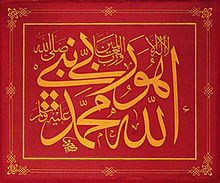
And this finally makes me think of Islamic art, where very often no graphic expression besides the words of the Qur'an themselves is allowed. 

The West, in many respects, is an image-dense culture.  It is interesting to see the way in which these text-dense approaches can catch us by surprise or strike us as a novelty.  We seem to naturalize the image as the norm, and imagine text as the substrate of our visual lives.  As these several examples show, this is hardly the actual case.

Saturday, June 9, 2012

SBL funds new Society for Koranic Studies

An announcement appeared in the Chronicle of Higher Education earlier this week about the formation of a new scholarly society to "support scholarship and teaching about the Koran in its historical, religious, and cultural contexts."

This undertaking, headed by the Society for Biblical Literature, is supported by a $140,000 grant from the Henry Luce Foundation.

John Kutsko,  executive director of the SBL, is reported in the Chronicle as saying the intention for this new Koranic Studies society is that it be "independent," and he says he and his fellow organizers are eager to avoid being seen as presumptuous or as exhibiting a colonialist attitude. "We have no preconceived and presumed ways of reading," he reiterates.

You can read the full text of the Chronicle article here.

[The above was paraphrased from the Chronicle article, and should not be understood to represent original reportage.  Thank you to Professor Scott Newstock of Rhodes College for bringing the article to my attention.]

Friday, November 18, 2011

Report from the AAR pre-conference meetings

I arrived Thursday afternoon, and have been having a very fruitful set of discussions with colleagues as part of the Society for Scriptural Reasoning pre-conference plenary.

Peter Ochs, the organizer, has characterized the discussions as "the first Abrahamic revival meeting." Our sessions were divided between time spent doing SR around a collection of texts on music, and discussions of the future of SR practice in Europe and North America.

For the music study, we looked at several Suras from the Qur'an, a passage from Chronicles, and a passage from the Book of Revelation. What I found most fascinating (and had not known before beginning the study) is that there is no mention of music in the Qur'an. I found that incredibly surprising, but as time went on, that fact opened up an amazing discussion about the way in which interpretive traditions will insinuate and "read" things into texts that are not literally present, and the hermeneutic problems (and possibilities) that ensue.

This evening I will participate in a second (and unrelated) pre-conference symposium dealing with the upcoming edited anthology from the Liturgical Press's Rock and Theology project, to which I have contributed a chapter.

Exhausting day, but a really good day as well.